Farm Input Distribution for Cassava & Yam Farmers
A farm-input distributor gives farmers what they need to grow, before the harvest happens. Seeds, fertiliser, and tools are supplied on credit or subsidy across a network of 2,000+ smallholder farmers. But with cash, inputs were being diverted, records falsified, and reconciliation running months behind.
With Swyp, every registered farmer receives a pre-loaded digital wallet, redeemable only at authorised input suppliers and only for approved input categories. The farmer taps to collect their allocation the system records exactly what was taken, by whom, at which distribution point, and when, in under 5 seconds. At harvest, the distributor's supply planning dashboard shows real demand patterns across every region, eliminating stockouts, reducing over-ordering, and giving leadership a live view of input utilisation across the entire network.
Cashless canteen payments for a boarding school
Students at a boarding school in Kwale relied on physical cash for meals and snacks at the canteen cash that got lost, stolen, or mismanaged by young students, with no record of what was bought or by whom. Partnering with an education-focused NGO active in the region, SynqAutomation rolled out Swyp to give each student a pre-loaded wallet, topped up by parents or the NGO's sponsorship programme online, redeemable only at the school canteen. Students tap to pay for meals in seconds, while the school and the NGO get a live dashboard of canteen sales and balances, with zero cash handled on site.
Tap-to-pay street parking across Kigali
On-street parking relied on attendants issuing paper tickets and collecting cash curb-side long queues, under-reporting, and little enforcement data for the city. Swyp parking terminals at metered zones now let drivers tap to pay by the minute, with live occupancy and revenue dashboards for the operator.
Automated stock reconciliation for a tea warehouse
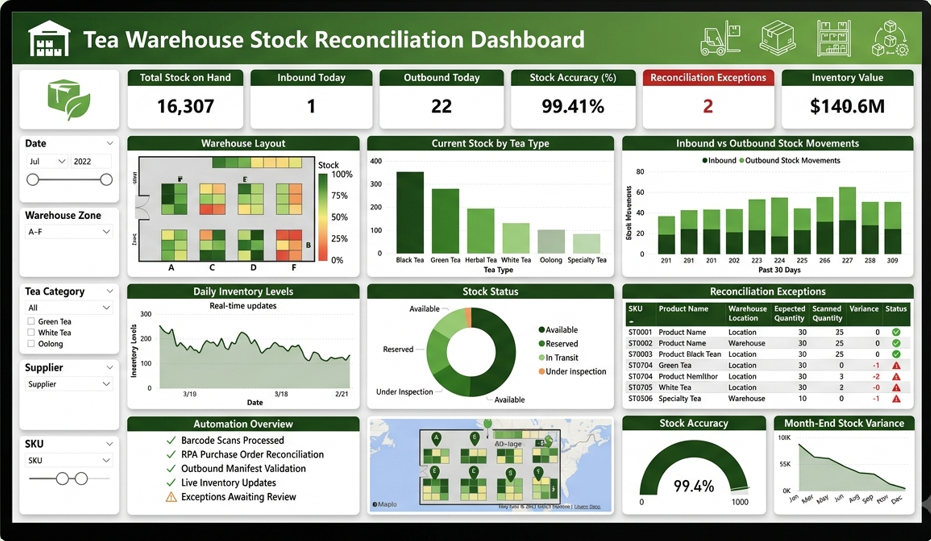
Grade, batch, and origin were tracked across paper goods-received sheets, picking slips, and a spreadsheet updated at the end of each shift, across black, green, herbal, white, oolong, and specialty tea lines. Counts drifted from what was actually on the racks, month-end stocktakes routinely surfaced unexplained variances against a multi-million-dollar inventory, and finance couldn't trust the numbers without a physical recount.
We automated the warehouse's stock movements end-to-end: barcode scans at receiving and dispatch post directly to the inventory system by zone, RPA bots reconcile scanned quantities against purchase orders and outbound manifests, and any variance is flagged as a reconciliation exception for review instead of triggering a manual recount. A live dashboard now shows stock on hand, inbound vs. outbound movement, and stock accuracy by tea type and warehouse zone, updated the moment a pallet moves.
Demand forecasting dashboard for a multi-branch retail chain
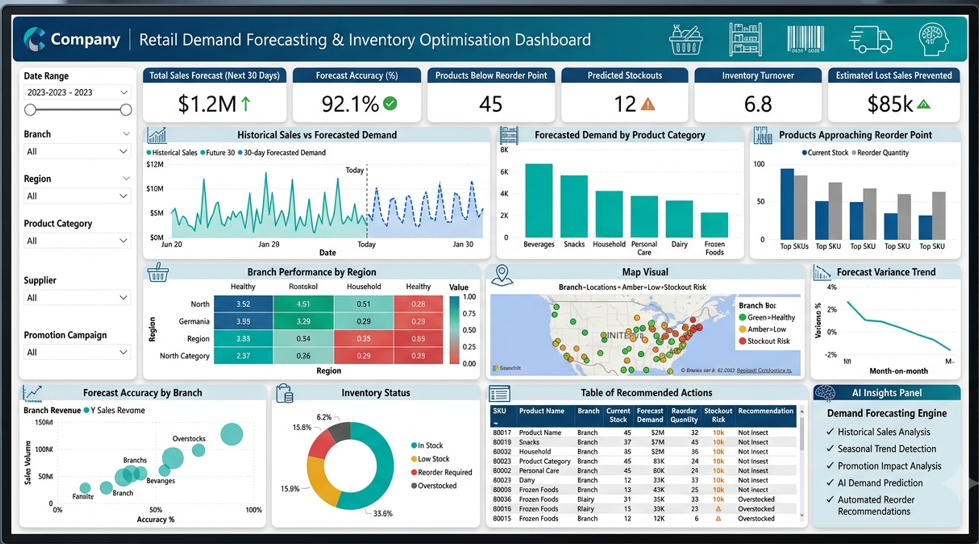
Branch managers ordered stock on gut feel and last month's spreadsheet, leading to shelves that sat empty on fast-moving lines and slow-moving stock tying up working capital elsewhere. Head office had no visibility into demand patterns until the month-end report landed, by which point the ordering decision had already been made.
We built a forecasting layer on top of the chain's existing POS and inventory data: a model trained on historical sales, seasonality, and promotions predicts branch-level demand by SKU, feeding directly into a live dashboard that flags reorder points before stockouts happen. Regional managers see forecast accuracy and variance by branch, and ordering shifts from a manual monthly exercise to a system-guided, weekly one.